Welcome to BIM Technologies
  
Artcore
  • Home
  • Services
  • Products
    • Autodesk
    • Bentley
    • Request Free Trial
  • Training
    • Autodesk Training
    • Bentley Training
    • Tekla Training
    • MS Project Training
    • Primavera P6 Training
  • Upcoming
  • Recruitment
  • Contact us

Upcoming Events

[searchandfilter fields=",category,post_tag" headings=",Dates,Cities & Countries" hierarchical="1"]

Author: BIM TECHNOLOGIES

Boost Your Project Management Skills with Microsoft Project Training !

Project management can be defined as the planning, organization, monitoring, and control of all aspects of a project. When discussing a project, four essential parameters are often considered: objectives, costs, deadlines, and implementation conditions.

Managing a project successfully isn’t always easy, especially when faced with multiple demands and deadlines. However, joining in Ms Project training in Sydney can make all the difference between disorganized management and a clear, efficient process.

Microsoft Project (MS Project) is project management software created natively for project managers so that they can best manage their projects.

To learn how to create a project in Microsoft Project, in this blog, we’ll guide you step-by-step so you can create an effective project using Microsoft Project, ensuring you maintain a clear vision and focus at every stage of the project.

What is Microsoft Project ?

Microsoft Project is the most widely accepted project management software worldwide due to its ease of use and versatility. Using MS Project is fundamental to ensuring the successful planning and execution of projects.

Through its application, managers can manage resources, evaluate budgets, create schedules, measure performance, analyze opportunities, and assess risks. With the correct use of this software, you have total control over your projects and are prepared to make strategic decisions.

Microsoft Project Features :-

There are many features that project managers and their teams need to better manage their work, and MSP has several. However, to give you a complete picture,

Here is a list of all the features available to those who opt for the top-tier plan offered by Microsoft 365 :

⟳ Grid view : project view used to plan and manage projects with a task list.

⟳ Map view : A Visual kanban board view that helps manage workflow and task status.

⟳ Chronological display : a traditional Gantt chart used to plan tasks on a project timeline.

⟳ Communication & Collaboration : enables teams to work together on projects.

⟳ Co-creation : stakeholders and team members work together to modify and update task lists and schedules.

⟳ Reports : Reports that allow tracking of progress, resources, programs, and portfolios.

⟳ Roadmap : This allows for the monitoring of programs and project portfolios.

⟳ Timesheets : We use them to collect project and non-project time for payroll and invoicing.

⟳ Resource management : Helps manage resources by requesting and assigning tasks.

Why use MS Project ?

The use of MS Project is fundamental to ensuring the success of project planning and execution. Its features allow managers to manage resources, evaluate budgets, create schedules, measure performance, analyze opportunities, and assess risks. By using this software, you have complete control over your projects. In other words, it allows you to make strategic decisions.

Through its use, you can also plan activities, track deadlines, define costs, allocate resources, and qualify the importance of a project as a whole. One of the strengths of MS Project is its adaptability to different circumstances.

You have a major decision to make about your project, and it could determine its success. So you’re wondering: how do I make the right choice? Or what’s the best strategy to adopt ?

Questions You May Have About MS Project :-

This is where MS Project comes in. It allows you to find quick answers to these types of questions. Here’s a short list of common questions :

(i) What tasks do I need to perform ?

(ii) Is there a specific order to follow when performing them?

(iii) How will I know the deadlines for each task?

(iv) Who will be part of these processes?

(v) What will the expenses be?

(vi) How should I communicate the specifics of the project to those involved in the project ?

You will be able to clarify all these questions by using the MS Project application for managing your project.

What are the advantages of MS Project ?

One major advantage is that it’s a Microsoft tool, so it works smoothly with other Microsoft products like Microsoft 365, Skype, and SharePoint.

Also, there are other benefits such as :

(1) Increased Productivity :

    With advanced planning and monitoring tools, Microsoft Project helps increase team productivity. The ability to visualize schedules, manage resources efficiently, and generate detailed reports allows project managers to keep everything under control, minimizing delays and unforeseen events.

    (2) Full Integration with Microsoft 365 :

    Integration with Microsoft 365 is a major advantage of Microsoft Project. This connectivity facilitates information sharing and collaboration between different tools, such as Excel for data analysis, Word for documentation, and Teams for real-time communication.

    (3) Flexibility and Scalability :

    Microsoft Project is suitable for both small projects and large corporate initiatives. Its flexibility allows you to adapt the tool to the specific needs of each project, while its scalability ensures you can manage multiple projects simultaneously without losing efficiency.

    (4) Informed Decision Making :

    With access to detailed data and comprehensive reports, project managers can make more informed decisions. Microsoft Project offers valuable insights into project progress, resource utilization, and potential risks, helping to ensure that decisions are based on accurate and up-to-date information.

    What are the main tasks performed by MS Project ?

    Now that we know what MS Project is and its importance for project management, we need to talk about the tasks that this software performs.

    The main tasks performed by MS Project are :

    (i) Drafting various types of reports

    (ii) Integration with team members via chat

    (iii) Create a clear overview of the entire project timeline

    (iv) Managing resources, whether financial, human, or physical

    (v) To improve the organization and structuring of plans

    Why is it necessary to train in MS Project ?

    In addition to being a powerful tool, Microsoft Project guarantees optimal project management. Experience shows that good project planning allows you to anticipate and address problems and risks so that the project is completed in full compliance with constraints. Therefore, mastering good project management software allows you to complete your projects with minimal risk and maximum profit.

    MS Project allows you to create tasks for each project, define links between them, assign teams, control completion times, progress status, follow any strategy using management templates, in addition to generating reports in Word, PDF and HTML format.

    You can also manage your project resources, define costs, and analyze your business data in the form of tables, graphs, diagrams, etc. One of the most significant advantages is the ability to change project parameters according to different scenarios. This feature is very useful because it saves time by allowing users to change one or more parameters, either during or before the project begins, to examine possible scenarios and make informed decisions.

    It is also important to mention the ability to control the project’s progress. With MS Project, the project manager can monitor all aspects of their projects at any time.

    This shows that MS Project is more than just a management tool. It is very powerful software that covers all aspects of project management, from the first planning stage to the final monitoring stage.

    This is very interesting software that undoubtedly allows you to maximize company profits and minimize project completion times, which are key factors in your success. MS Project training may seem like a simple step, but it has amazing long-term results for your business.

    Want to learn more about MS Project ?

    As we’ve seen throughout this article, MS Project is a powerful tool for project management, being the most widely used software on the market today for this purpose.

    Although it is a complete tool that delivers excellent results for the companies that use it, many organizations still do not use this software due to a lack of professionals trained to operate it. So, if you are looking for the best MS Project training centre in Christchurch, Auckland, Wellington, get in touch with BIM TECHNOLOGIES. We are the best professional development centers that teach project management theory and practice in Microsoft Project.

    Having accumulated extensive experience in both individual and corporate Project training, and employing only certified instructors, we can guarantee that not only beginners but also professionals will gain a wealth of new and useful information from our courses.

    So don’t wait any longer, join us to get the Microsoft Project Specialist (CMPS) Certificate!

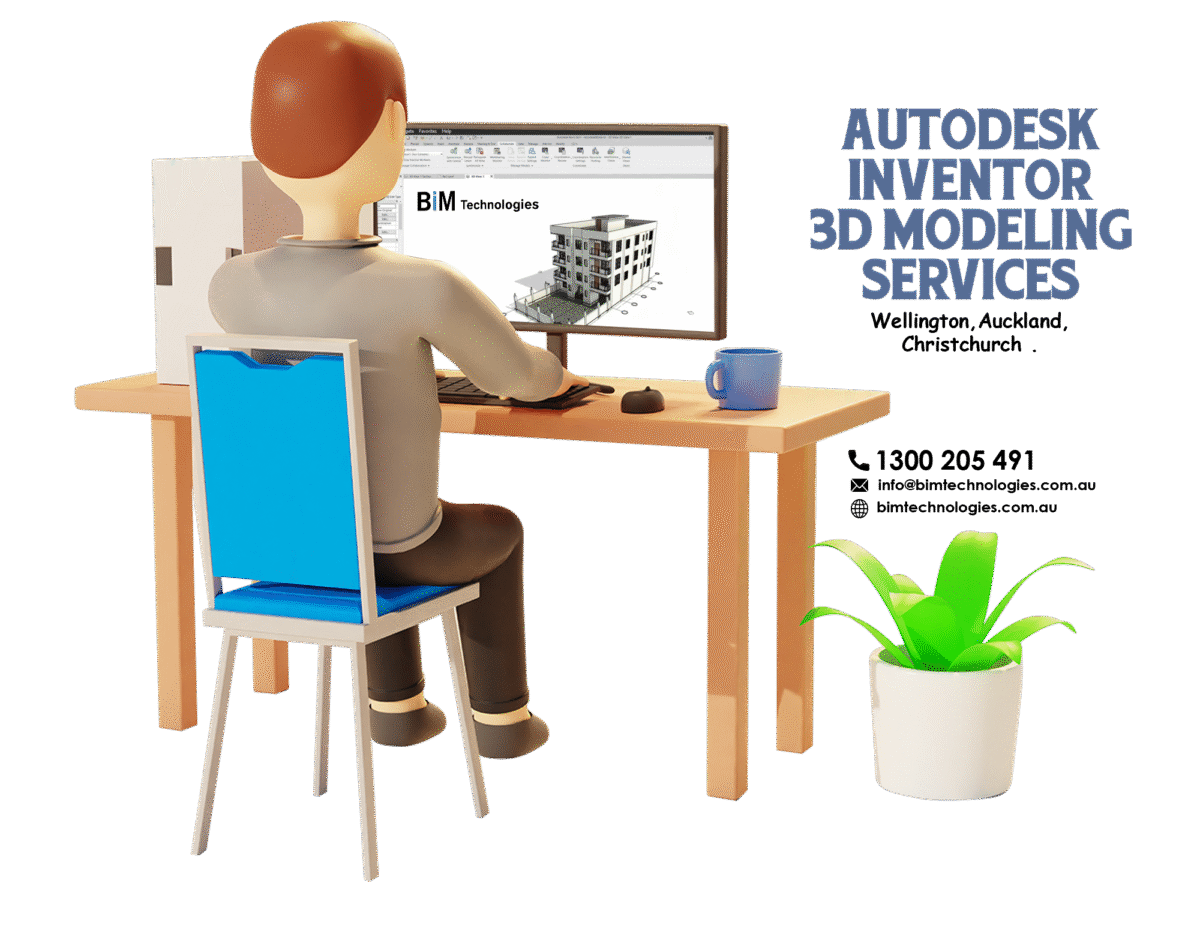
    Build With Precision through Autodesk Inventor 3D Modeling Services

    Transform your ideas into reality with our top-notch Autodesk Inventor 3D modelling services. Serving Sydney, Melbourne, Wellington, Auckland, and Christchurch-bimtechnologies

    Build With Precision through Autodesk Inventor 3D Modeling Services

    In today’s fast-moving world of design and manufacturing, owning the right tools and equipment can make a massive difference. For instance, the Autodesk Inventor, a powerful 3D modeling software allows the users to bring their ideas to life with precision and ease. Whether you’re designing mechanical parts, complex assemblies or custom products, this software can easily turn some basic concepts into fully functional models.

    Moreover, its user-friendly features, automation tools and seamless file compatibility make it a top choice for engineers and designers alike.

    In this blog, we’ll explore how Autodesk Inventor 3D modeling services in Wellington, Auckland and Christchurch can simplify your workflow, improve accuracy, and speed up your journey from idea to reality .

    A Brief History of Autodesk Inventor :-

    Autodesk Inventor offers professional-grade 3D CAD solutions for manufacturing professionals. This software aids in improving the performance of the product with the help of powerful 3D modeling and simulation capabilities.

    In this software, the users can rapidly create custom design configurations as well as automate routine tasks. Furthermore, the collaboration ability of this software allows the user to control, track and design various project files.

    Essential Features of Autodesk Inventor 3D Modeling Services :-

    [1] Parametric modeling :

    This software allows the user to perform automation of repetitive changes with the help of an intuitive user interface. As a result, the users of this software could utilise their time and focus on designing the software.

    [2] Shared view collaboration :

    The users of this software can seamlessly collaborate with the key stakeholders with the help of the shared view option. This establishes communication between both parties regarding the design progress and iteration. Interestingly, this feature works on every device.

    [3] Design configurations :

    Most importantly this software promotes the creation of new configurations of their design quite rapidly. This configuration allows the user to increase their speed of performing the 3D modeling process.

    [4] Model-based definition :

    The basic purpose of efficient 3D software lies in adopting manufacturability abilities. Similarly, the Autodesk Inventor skilfully includes the manufacturing information within the 3D model, creating a pathway for the user to construct the project.

    [5] Assembly modeling :

    Well, the users of Inventor facilitate the creation of part files. These part files are later used to build assemblies (placing the individual parts together) in the project. This offers a vivid idea to the user regarding the functionality of the project.

    This feature is indeed useful as the users can have a brief idea about the functionality of parts before the initiation of the manufacturing process. Besides, this feature allows the user to detect possible errors, saving a significant portion of time, money and effort.

    [6] Non-native data :

    Besides Autodesk Inventor, there are several CAD (Computer-Aided Design) programs out there that are easily available in the market. Yet sometimes, sharing files between these programs could emerge as a major problem because they don’t always work due to the lack of synchronization.

    One cannot find this issue emerging from Autodesk Inventor. This software allows the user to open non-native designs (designs that have been made in other CAD software) directly on the interface without needing to convert or change the format of the file.

    [7] Automated frame design :

    The never-ending task of designing structural frames can consume a massive portion of time because you have to make use of the standard parts to create a perfect steel frame.  Well, Autodesk Inventor helps by automating this tedious work. All you need to do is insert the appropriate commands and the rest of the work would be handled by this software.

    [8] Content center :

    After installing this innovative software, you would gain access to a huge library of ready-to-use parts which contains over 750,000 standard components for 3D design. Interestingly, you can also create your own custom parts and add them to your personal library to use again in future designs.

    [9] Quick creation of drawing :

    The best part about this software is that it can accurately create 2D drawings from 3D models. These drawings include everything needed for manufacturing. Moreover, if you update the 3D model, the 2D drawing gets updated automatically. This ensures both the 3D model and 2D remains completely accurate.

    [10] Sheet metal :

    The Inventor software offers a sheet metal environment, allowing the user to effortlessly draw, design, model or shape the metal. This helps when you are designing large products and each of those products is made from sheet metal, making the process smooth and accurate.

    Conclusion :-

    To summarise, the Autodesk Inventor 3D modeling services in Wellington, Auckland and Christchurch enable engineers and designers to transform their ideas to life quite precisely and quickly.

    And if you require professional assistance with your project, then make sure that you contact the experts of BIM Technologies. The dedication displayed by our experts would ensure that your project gets completed without encountering any kind of clashes during the construction phase.

    As Built Modelling Services – Delivering Precision on Every Construction Project!

    Get accurate As Built Digital Modeling Services in Wellington, Christchurch & Auckland. We create precise 3D models for your projects-bimtechnologies

    As Built Modelling Services – Delivering Precision on Every Construction Project!

    In today’s fast-moving world of design and construction, accuracy is everything. Whether you’re planning a renovation, managing a facility, or building from the ground up, having a clear and reliable view of your project is essential. That’s where As-Built and Digital Modelling Services come in .

    These advanced tools transform real-world spaces into detailed digital models, capturing every wall, wire, and window with precision. From reducing costly errors to improving collaboration, they’re reshaping how architects, engineers, and contractors work.

    Understanding Digital Modelling Services and Their Significance :-

    The process of creating a vivid, detailed digital representation of various physical objects, structures or spaces with the help of specialised software is known as digital modelling. The models that are generated out of this process are often used in the architecture, engineering, construction, manufacturing, and product design industries.

    These models aid in visualising, stimulating, and analysing various real-world elements before they are even built or modified. Moreover, the models that are generated out of these Digital modelling Services in Wellington, Christchurch, and Auckland can range from simple conceptual shapes to data-rich structures, including detailed information.

    Based on the industry and its emerging trends, digital modelling services might integrate the use of various kinds of tools like BIM (Building Information Modelling), CAD (Computer-Aided Design), and 3D rendering to enhance the design accuracy and efficiency of the project.

    Well, here are some points that clearly state the growing significance of this service within the related industries :

    (1) Enhanced visualisation :

    As discussed, digital modelling services offer highly detailed and realistic visualisations of the design, allowing the clients as well as the project team members to have a clear understanding of the design intent.

    Also, this kind of detailed drawing aids in making well-informed decisions. This aids in streamlining the design process by promoting rapid exploration and refinement of the ideas while successfully eliminating the expense of physical prototypes.

    (2) Improved communication and collaboration :

    The digital models act as a shared visual language that enhances both communication and collaboration among the project stakeholders. This kind of transparency ensures that you have a clear and consistent understanding of the project vision and details.

    This mitigates the occurrence of miscommunication. On top of that, this kind of cloud-based 3D design platform supports real-time collaboration, allowing the team members to work on the same model simultaneously.

    (3) Increases project efficiency and productivity :

    Did you know that Digital Modelling Services Wellington streamlines the design process by automating the routine tasks? This service offers a comprehensive view of the project, which ends up saving a massive portion of time, effort and energy as compared to the manual approach.

    The users can experience faster prototyping as they can freely test and refine their ideas before building the actual physical model. This aids in reducing the development costs as well as accelerating production.

    (4) Savings of cost :

    The most important part of digital modelling services is that they play a pivotal role in mitigating the amount of rework by precisely identifying the flaws in the design at an early stage. As a result, the investor won’t have to incur any costly correction expenses during the actual production or construction stage.

    Moreover, during the virtual testing and simulation stage, the need for multiple physical prototypes is reduced. This significantly lowers the prototype cost and accelerates the project timelines.

    Exploring the Key Benefits of Using Digital Modelling Services :-

    Under digital modelling services, the user may find the use of various kinds of tools that can bring accuracy, efficiency, and smarter decision-making to the design and development process.

    Apart from that, here are some of the interesting benefits the users could derive from Digital Modelling Services in Christchurch :

    (a) Visualisation :

    Digital models provide realistic representations that help clients, stakeholders, and teams clearly understand design intent, reducing guesswork and boosting confidence in decision-making.

    (b) Rapid design iterations :

    With the help of the digital models, users could easily and rapidly explore and refine multiple ideas without incurring any additional cost or delay of the physical changes. This flexibility leads to better outcomes and encourages creative problem-solving.

    (c) Early error detection :

    By identifying design issues in the digital phase, teams can avoid costly rework during construction or production. It’s a proactive approach that saves both time and money.

    (d) Better resource planning and cost control :

    The clear and concise digital models offer accurate quantity take-offs, virtual prototyping, and optimised material use, all of which lead to more efficient workflows and reduced waste.

    How Has the Industry Been Revolutionised by Digital Modelling Services ?

    The innovation of Digital Modelling Services in Auckland has truly transformed the way the industries plan, design, and execute various kinds of projects.

    The once time-consuming and hectic manual process has now been replaced with a fast, precise and collaborative experience.

    Let’s take a look at the various kinds of industries where these kinds of services are used quite popularly :

    (i) Architecture, Engineering, and Construction (AEC) :

    The use of digital models aids in planning, visualisation, and coordinating stages. The design of complex structures can now be modelled with incredible detail. This eventually helps the teams to detect clashes and errors before the actual construction phase even begins.

    (ii) Manufacturing and product design :

    Digital models offer rapid prototyping and virtual testing, which aids the designer to create, test, and refine products without the high costs of physical prototypes.

    (iii) Entertainment and gaming industry :

    Well, this industry has also embraced the use of digital models as they aid in creating lifelike characters, immersive environments, and seamless animations. It has enhanced storytelling while reducing production time.

    (iv) Healthcare and medical device industry :

    This industry has also started to use digital modelling services to create custom implants, surgical planning, and medical simulations, which results in improving the outcomes and patient safety.

    How Does As-Built Modelling Services Work ?

    Unlike the digital modelling services, the As-Built modelling services in Christchurch are quite different as they facilitate creating highly accurate 2D or 3D digital models that reflect the current state of the project exactly as it exists.

    As compared to the other design models, which are based on plans or assumptions, the as-built models are made from real-world data which are collected either during or after the construction.

    Initially, the data is collected with the help of advanced tools such as 3D laser scanning or LiDAR. These tools can capture millions of data points, which represent the physical space in precise detail.

    The scanned data is now imported into the modelling software, where the skilled users convert the necessary information into accurate digital representations. Based on the requirements of the project, different kinds of elements are added to the project.

    Evaluating the Significance of As-Built Modelling Services :-

    (a) Accurate documentation and record keeping :

    As-built modelling provides a precise digital record of the completed project, capturing all changes, modifications, and deviations made during construction. This accurate documentation serves as a reliable reference for future assessments, maintenance, and renovations, helping to reduce confusion and prevent the risks associated with relying on outdated or inaccurate information.

    (b) Improved planning for renovation work :

    As-built modelling provides architects and engineers with a clear and accurate view of the existing structure, making it easier to plan modifications that align seamlessly with the original construction. This detailed understanding helps minimise unexpected obstacles and reduces the risk of errors during renovation or expansion projects, leading to smoother workflows and more reliable outcomes.

    (c) Value engineering and estimation of cost :

    Accurate as-built models enable contractors and estimators to precisely calculate material quantities, labour requirements, and associated costs, providing a solid foundation for detailed planning. This level of precision supports more accurate budgeting and improved cost management, ultimately enhancing project efficiency and increasing overall viability.

    (d) Enhanced communication and collaboration :

    As Built modeling services in Wellington provide a shared platform where architects, engineers, contractors, and other stakeholders can communicate effectively and make informed decisions based on a unified, accurate representation of the project. According to Built-in BIM, BIM-based as-built models enhance visualisation and coordination, helping teams stay aligned and reducing the risk of miscommunication throughout the project lifecycle.

    (e) Enhanced facility management and operations :

    As-built models offer detailed information about a building’s systems and components, such as HVAC, electrical, and plumbing, enabling efficient planning and execution of maintenance tasks. Facility managers can integrate these models with Computerised Maintenance Management Systems (CMMS) to streamline maintenance workflows, quickly locate equipment, and access accurate specifications.

    This integration not only expedites repairs and upkeep but also supports better asset tracking and lifecycle management, helping extend the longevity and performance of building systems.

    (f) Clash detection and coordination :

    As-built modelling services also make use of the Building Information Modelling tools to detect as well as resolve the conflicts present between the building elements. This kind of proactive approach aids in minimising the costly rework, delays, and increases the overall project efficiency and quality.

    (g) Mitigation of risk and safety of the project :

    As-built models serve as reliable legal documents that demonstrate compliance with building codes and regulations, offering critical evidence in case of audits or disputes. They also play a vital role in emergency preparedness by providing first responders with accurate building layouts and information on critical systems, improving safety and response times.

    Additionally, these models help minimise the risks associated with potential liabilities or lawsuits by clearly documenting the final constructed state and reducing ambiguity around construction defects.

    How to Create As-Built Models ?

    Creating accurate as-built models involves a combination of on-site data collection, advanced technology, and skilled digital modelling. The process ensures that the final model, which has been generated through As-Built modelling services in Auckland, reflects the true, built conditions of a structure by accounting for all changes, deviations, and updates made during construction.

    Here’s how it’s typically done :

    (1) Site survey and data collection :

    The first step is to capture real-world conditions of the site using tools like 3D laser scanning or LiDAR. These technologies generate a detailed point cloud, which is a set of data points in space that represent the surfaces of the structure with high accuracy.

    (2) Data processing and cleanup :

    Once the scan gets completed, the raw point cloud data is imported into modelling software. At this stage, technicians clean up the data by removing unnecessary noise, aligning multiple scans, and preparing it for accurate modelling.

    (3) 3d model creation :

    Using software such as Revit, AutoCAD, or other BIM platforms, the cleaned data is then converted into a 2D or 3D model. This model includes architectural elements, structural components, and systems like HVAC, plumbing, and electrical, depending on the project’s scope.

    (4) Quality Checks and Validation :

    The model is carefully reviewed and validated against the site data and any existing design documents. This ensures all details are accurate and any discrepancies between the original plans and the actual build are reflected correctly.

    (5) Final Delivery and Integration :

    The completed as-built model is delivered to the client in the required format. It may also be integrated with systems like CMMS (Computerised Maintenance Management Systems) or used for future renovations, facility management, or legal documentation.

    Conclusion :

    To conclude, As Built modelling Services Wellington, Christchurch, Auckland provide a precise, reliable digital record of existing structures, enhancing planning, maintenance, and future renovations.

    By capturing real-world conditions accurately, they reduce errors, improve collaboration, and support smarter decision-making, making them an essential tool in various industries. And, if you are interested to learn more about this particular service, make sure that you call up the experts of BIM Technologies .

    Explore The Power Of Built And Digital Modelling Services-A True Virtual Replica Of Architecture

    We take your designs As Built,turn them into detailed digital models from Wellington to Perth,we cover all the major cities,Christchurch,Sydney,Melbourne-bimtech

    Explore The Power Of Built And Digital Modelling Services-A True Virtual Replica Of Architecture

    In the construction and facility management industry, modern construction technologies and materials play a crucial role in driving the development of the construction sector. It offers new opportunities to improve the efficiency, quality and sustainability of construction projects. The importance of modern technologies and materials in construction lies in their ability to address current challenges, such as high costs, lengthy construction periods, and a negative environmental impact.

    In this regard, you can take the name of As-Built and Digital Modelling Services in Wellington, Christchurch, and Auckland. Both of the tools are essential in modern construction and engineering, providing precise, detailed representations of existing structures and environments.

    Both of the tools enable stakeholders to accurately document as-built conditions, facilitate efficient renovation and maintenance, and support seamless integration with digital workflows such as Building Information Modelling (BIM).

    By leveraging advanced scanning technologies and digital modelling techniques, these services enhance project accuracy, reduce errors, and streamline decision-making processes.

    Therefore, to know more about both of these services, you have come to the right place.

    What is a digital modelling service ?

    Digital modelling service can be defined as a collaborative process based on intelligent three-dimensional models that encompass the creation, management and sharing of information about a construction project. BIM allows architects, engineers, builders, owners and other stakeholders to work in an integrated manner, sharing data and information in a centralized model throughout the life cycle of the built asset.

    In BIM, the three-dimensional model contains detailed information about the project elements, such as walls, floors, doors, windows, structural elements, electrical systems, and air conditioning systems, among others. In addition to geometry, the model can contain physical properties, technical characteristics, costs, deadlines, maintenance information and any other information relevant to the project’s life cycle.

    By adopting digital modelling Services in Wellington, Christchurch, and Auckland, it is possible to achieve a significant reduction in compatibility errors, optimization of deadlines, greater reliability in projects, as well as more precise planning and control processes for works. This approach also drives increased productivity, while contributing to the reduction of costs and risks involved, resulting in savings in the resources used.

    Thus, it is clear that this methodology is a revolutionary approach that drives efficiency, reliability and quality in all aspects of the construction industry. It offers benefits both to those directly involved in the process and to society as a whole.

    Features of digital modelling service :–

    (1) Reduced rework :

    With digital modelling services in Wellington, it is possible to have all the bases stored in the system, without wearing out the materials due to handling and storage when storing manually.

    (2) Improvements in production processes :

    Due to the agility and precision of the CAD system for modelling, manufacturing has greater productivity, quality and standardization of processes.

    (3) Automatic Grading :

    With the use of digital modelling, it is possible to automatically grade the moulds. The manual gradation process takes about 2 hours depending on the model of the piece. When making digital moulds, this process takes up to 10 minutes.

    (4) Speedy measurement checking :

    With the digital tape measure tool, you can compare measurements, check and make calculations in just a few minutes, both for base moulds and graduated moulds.

    (5) Unlimited collection of moulds :

    With cloud technology, the moulds are all stored in the system, without taking up internal storage and running the risk of losing the files if a problem occurs on the computer.

    Freedom to generate patterns for printing, exporting and importing :-

    After completing a pattern or cutting order, export the files in the desired format to print on the plotter or cutting machine.

    (i) Intuitive and simple interface :

    Modelling systems are intuitive and simple to use, for those who already know digital modelling or are starting to use it in their business.

    (ii) Fabric savings :

    With automatic fitting technology, manufacturing reduces fabric loss, consequently increasing production and also generating a complete cost report.

    (iii) Ergonomics :

    Working with ergonomics is essential to achieve quality and produce with excellence. With the digital system, manufacturing generates quality of life for employees because they do not need to spend hours standing in production performing automatic fitting.

    (iv) Integration :

    With the modelling system, it is possible to integrate modelling, fitting, cost sheet and technical sheet, so everything related to clothing production is concentrated in a single system.

    What is As Built modelling Service ?

    As built modelling is a set of documents, drawings and information that represent the actual state of a building after its completion. This documentation accurately reflects how the project evolved during the construction phase, including all changes, modifications or adjustments that occurred during the process.

    You can consider As Built modelling Services Wellington, Christchurch, Auckland as the updated version of the original project drawings and specifications. These documents reflect the actual conditions of the building, including any variations from the original design. This documentation is essential to ensure the accuracy, quality and compliance of the construction with established standards.

    Features of As-built modelling service :–

    They perform a number of crucial functions in the construction industry and are vital to a number of stakeholders.

    Here are some of their main purposes :

    (a) Accurate Recording :

    “As Built” reports provide an accurate record of what was built. This is essential to ensure that the final structure matches specifications and meets quality standards.

    (b) Documentation of changes :

    As construction progresses, changes, adjustments, and modifications to the original design may occur due to unforeseen circumstances or planned improvements. “As Built” reports document these changes, providing a clear view of how the project has evolved.

    (c) Maintenance and repairs :

    “As Built” reports are valuable for future maintenance, repairs and renovations. They provide detailed information about the structure, systems and components, facilitating any necessary intervention.

    (d) Quality Assurance :

    As-built modelling services in Christchurch are used to verify that a building meets established quality and compliance standards. They are often used by engineers, architects, and inspectors to assess the integrity of a building.

    (e) Safety and emergency :

    Having access to the “As Built” information is essential in emergency or evacuation situations. It provides information on the location of security systems, emergency exits and other important aspects of building safety.

    (f) Assessment of the asset value :

    In the event of a property being sold, the “As Built” reports are used to assess its asset value, as they provide an accurate description of the construction and its current condition.

    Why do you use “As Built and Digital Modelling Services” in civil construction ?

    This technology can be incorporated into civil construction in practically all stages of the project, from the first line of the drawing to the maintenance of the work. This makes it possible to understand several issues related to its performance, for example, by analyzing how the materials will resist over the years. However, its incorporation into civil construction goes far beyond these possibilities. Want to learn more? Keep reading !

    (a) Feasibility study :

    When carrying out the feasibility study of the work, an essential stage of its design phase, several technical tasks must be carried out with maximum precision. This is what makes a successful build.

    With the use of Digital Modelling Services Christchurch and As Built Modelling Services Wellington, it becomes easier to carry out all revisions of designs, layouts, ergonomics and other aesthetic aspects of the work.

    This happens because digital models have a great wealth of details. Thus, it is possible to carry out various analyses, such as topographical, lighting, thermal and even acoustic.

    (b) Planning :

    This technology can be a great tool during the construction planning phase. Among the resources, we can mention terrain analysis, dimensions and conditions. These studies are quick and greatly help designers to establish the foundations of the project. Another factor is the 4D Project.

    In addition to the 3D visual model, there is another element to add to the equation: time. This way, your team can simulate the passage of time and understand how the work will behave about the erosion of components or natural lighting. It is an essential study for planning maintenance actions, for example.

    (c) Budget :

    With Digital Modelling Services Auckland, we are not just talking about the production aspect: with the tool, it is possible to generate complete cost reports, which assist the team in charge of the Budget. An important point is that changes are allowed and are reflected in the reports automatically and in real-time.

    The system also allows you to make changes to the project that are reflected, in real-time, in the cost and quantity reports. This makes it much quicker to make adjustments and changes to the construction budget.

    (d) Construction :

    The BIM methodology is not just for the office. It can be essential on the construction site. One of the features is 3D Coordination, which enables joint analysis of the different structural 3D models of the project. This way, your team of designers and specialists can check for faults in a very short time.

    BIM also makes it possible to organize the construction site, simulating spacing as construction progresses which enrich your construction management.

    (e) Maintenance and Operation :

    In this case, As-Built Modelling Services Auckland can play a highly relevant role in the maintenance and operation phase of the project. With the platform, it is possible to create a complete record of all parts of the work both during the design phase and after its implementation.

    After the work is finished, BIM still proves useful: the platform can help in the management of assets, such as water and electricity systems, assisting in maintenance planning.

    In projects that have an automation system, BIM can be used for in-depth analysis to identify possible points of failure.

    5 advantages of investing in Digital Modelling and Built modelling :-

    Investing in this technology is a wise decision for construction businesses. But of course, just talking isn’t enough, right? Therefore, we have listed some of the advantages of adopting 3D modelling services such as Digital Modelling and As Built modelling in your business !

    (i) Better project visualization :

    Digital Modeling and As Built modelling enable a complete, transparent and detailed visualization of all aspects of a project. Here, it is not just about the visual input, but the technical reference of all the elements that make up the work.

    (ii) Cost reduction :

    The use of Digital Modeling and Built modelling software allows the project team to organize each operational execution of the work, facilitating strategic work. This harmony is possible due to the detailed level of information available. This way, you reduce costs, especially with rework, as each operation is simulated in BIM, anticipating failures and identifying opportunities for improvement.

    (iii) Increased productivity :

    As the data you saw above shows, productivity is one of the main benefits of adopting Digital Modeling and As-built modelling. Technology speeds up all stages of the project, facilitating the production routine, as well as approvals.

    (iv) Team integration :

    The model allows greater integration of the sectors involved in the work, not just the Projects and Purchasing sectors. Using Digital Modeling and As Built modelling will facilitate access for everyone involved in the process, as well as external stakeholders such as investors, real estate agencies, etc. This way, the exchange of information is constant and fast, as is decision-making.

    (v) Greater accuracy :

    BIM enables greater precision in project development, precisely because it allows different levels of analysis of what is involved in construction. This way, you and your team map out the critical points of the work, carrying out corrective actions efficiently.

    Conclusion

    In short, As Built and Digital Modeling Services is a valuable tool that helps maintain the integrity and reliability of buildings, ensuring that they meet established standards and the expectations of owners and the community at large. Therefore, creating and carefully maintaining the entire system is essential practice in all construction projects. To know more about this service, you need to contact BIM TECHNOLOGIES.

    Enhance Rail Infrastructure with Rail Corridor Modelling Services

    Enhance Rail Infrastructure with Rail Corridor Modelling Services

    Rail infrastructure projects demand accuracy, efficiency, and smart planning. To achieve these three important goals, most designers make use of the 3D software and create advanced rail corridor modelling. The advanced digital tools provide detailed, 3D representations of railway environments, helping engineers, planners, and contractors visualize and design with confidence.

    From track alignment to terrain mapping, rail corridor modelling reduces risks, improves decision-making, and streamlines project timelines.

    In this blog, we’ll explore what Rail corridor Modelling Services in Wellington, Christchurch, and Auckland involves, the  technology behind it, and why it’s a game-changer for modern rail development.

    Whether you’re upgrading existing lines or planning new routes, this service lays the foundation for safe, efficient, and future-ready rail systems.

    Exploring the Concept of Rail Corridor Modelling Services :-

    The process of creating a digital 3D representation of the railway line, including the track, surrounding terrain, and associated infrastructure, is known as rail corridor modelling. This particular service makes use of advanced technologies to generate accurate models that enhance multiple aspects of the railway projects.

    With the help of Autodesk 3D, the designers can easily build the model of a rail track corridor along with the required detailing. This particular service has been quite helpful for the railway engineers, engineering service providers, designers, and project engineers.

    Key Technologies Used in Rail Corridor Modelling Services :-

    (1) Building Information Modelling (BIM) :

    The use of BIM is quite crucial for creating detailed digital models of the railway infrastructure, enabling visualisation, analysis, and establishing collaboration across the entire project lifecycle. Additionally, BIM aids in reducing the overall cost of the project by identifying the issues at an early stage.

    (2) Light Detection and Ranging (LiDAR) :

    This technology offers highly accurate 3D data, which is required for designing a detailed terrain model as well as for feature extraction. This technology further aids in optimising the infrastructure planning, maintenance, and safety along the rail corridors.

    (3) Geographic Information System (GIS) :

    Well, GIS integrates with BIM and other data sources to provide geospatial context for the models, facilitating analysis and decision making with respect to the surrounding environment and other infrastructure elements.

    Key Components of Rail Corridor Modelling Services :-

    (i) Geometry :

    It includes the horizontal as well as the vertical alignment of the tracks, curves, and transitions.

    (ii) Terrain :

    It includes the existing ground surface, slopes, embankments, and cuttings, which are modelled with the help of the data being generated through LiDAR scans and digital elevation models.

    (iii) Assemblies :

    Includes the predefined cross-sections of the railway, including the track structure, ballast, and any associated structures.

    (iv) Templates :

    It is used to define the geometry and materials of the track structure, allowing consistent application along the corridor.

    (v) Corridor :

    This component ties together all other components, defining the extent and behaviour of the railway line.  

    Benefits Gained Through Rail Corridor Modelling Services :-

    As discussed, rail corridor modelling services are essential for delivering modern, efficient, and sustainable railway systems. By incorporating advanced technologies and collaborative workflows, the engineer could optimise every stage of the project, starting from the initial planning stage to its final execution.

    In addition to that, here are some of the benefits the users could derive from this particular service includes :

    (a) Better planning and design :

    Rail corridor modelling gives engineers and planners a clear, 3D view of the area where tracks and infrastructure will be built. This helps them design smarter, avoid mistakes, and make well-informed decisions before the actual construction phase begins. In a way, this service also prevents the occurrence of any kind of huge replacement costs.

    (b) Time and cost savings :

    The real-time progress tracking of this service aids in identifying the delays or obstacles at an early stage. As a result, the delays or expensive changes that might occur during construction get eliminated. This simple measure also speeds up the entire planning and approval process.

    (c) Improved safety :

    Detailed models that are generated out of this service show potential hazards and help in planning safer construction zones and track layouts. This eventually reduces the risk of accidents for both workers and future rail users.

    (d) Accurate and up-to-date data :

    Using tools like drones and 3D scanning, rail corridor modelling provides highly accurate and current information about the site. This leads to better-quality workflow and fewer surprises.

    (e) Easier collaboration :

    With a visual model, all teams, such as the engineers, surveyors, architects, and contractors, can see and understand the same data. This makes communication clearer and project coordination much easier.

    (f) Environmentally friendly planning :

    By understanding the land and surroundings, rail corridor modelling helps reduce environmental impact. Designers can adjust plans to avoid natural habitats, water sources, or sensitive areas.

    (g) Stakeholders’ communication :

    The best part about this service is that it facilitates a smooth flow of communication with the stakeholders. The detailed models that are generated out of this service display the crucial information to the stakeholders. As a result, this promotes transparency and fosters collaboration between the involved members of the project.

    Challenges Involved in Rail Corridor Modelling Services :-

    So far, it has been made clear that rail corridor modelling services involve creating a detailed digital representation of the railway network, track infrastructure, and surrounding terrain.

    However, there is are certain set of challenges which could influence the entire project, such as :

    [1] Acquisition and integration of data :

    One of the biggest strengths of rail corridor modelling is its ability to gather and use data from multiple sources. These include spatial data like terrain and track layouts, operational data such as train movements and signal positions, and environmental data for weather or land conditions.

    However, collecting accurate data over long and often remote corridors can be difficult and expensive. Specialized tools like LiDAR or drones are often needed to capture key measurements such as track geometry or wear.

    Once collected, this data must be integrated and standardized, which can be challenging due to differences in format, scale, and detail. On top of that, many rail systems still rely on outdated technologies, making it hard to connect with the new modelling tools that too with an old infrastructure.

    [2] Computational and technical complexities :

    Rail corridors are constantly changing due to train traffic, weather conditions, and ongoing maintenance. To manage these changes effectively, it’s essential to build highly accurate models that represent everything starting from the track curves to signal placements that too in fine detail.

    However, maintaining precision isn’t a one-time job as it requires real-time data updates and continuous processing, which can significantly strain the technical systems. Additionally, modelling must account for uncertainties such as uneven wear patterns or unexpected environmental impacts. This adds another layer of complexity, especially when predictions are used to plan maintenance or assess long-term performance under different conditions.

    [3] Modelling accuracy and precision :

    Modelling entire rail corridors generates an enormous amount of data, such as high-resolution maps to real-time monitoring of rail traffic. Processing all this information efficiently requires powerful computers and advanced algorithms. Even with the right tools, ensuring all systems communicate with each other is difficult because not all rail networks follow the same data standards or communication protocols.

    To create highly detailed and useful models, engineers may need to use advanced methods like machine learning or physics-based simulations, which require both deep expertise and substantial computing power. Without the right technical setup, projects can quickly become slow, costly, or error-prone.

    [4] Operational and project management challenges :

    Rail corridor modelling projects usually involve a wide range of stakeholders, including engineers, government agencies, safety regulators, and construction teams. Each group has its own goals, making collaboration and clear communication essential for success. Navigating strict regulatory requirements and maintaining the highest safety standards is also critical throughout the process.

    In addition, these projects often come with high costs which are both in terms of technology and skilled personnel. As rail networks move toward digital systems, cybersecurity becomes an important concern. Protecting sensitive data and ensuring system integrity must be prioritized to prevent disruptions or breaches.

    The above challenges need to be addressed in order to develop an effective and robust rail corridor modelling solution that supports efficient and safe railway operations and future network expansion.

    Conclusion :-

    Rail Corridor Modelling Services play a vital role in enhancing the planning, safety, and efficiency of modern rail projects. And if you want to execute your project with the support of such advanced tools, then make sure to contact the experts ata BIM Technologies.

    Our team streamlines the entire procedure and offers a complete view of the construction assignment.

    Ms Project Training: The Importance of Project Management and Control In Construction

    Ms Project Training: The Importance of Project Management and Control In Construction

    Construction project management is the process of planning, directing, and controlling the development of a project at a minimum cost and within a specified timeframe. This highlights the need for proper project management to avoid delays in the completion of the project or excessive increases in the final cost.

    A project can be defined as a set of interrelated and coordinated activities designed to achieve certain objectives using different resources, such as people and materials. These objectives must be achieved within a stipulated timeframe.

    So, if you want to plan a project error-free, then you need to join an MS Project Training in Melbourne. The difficulty of managing a project is largely due to the number of human resources involved. That’s why taking MS Project Training is the best alley for you.

    The course has been conceived and designed for all professionals who need to gain a deeper understanding of MS Project software or a higher version as a support tool for planning and controlling projects. This course will strengthen their knowledge and achieve greater benefits and improved results through software customization.

    Below, we will give you an overview of MS Project Training :-

    What are the Capabilities of MS Project ?

    Although MS Project is a project management tool familiar to many managers, working with it will not be easy even for experienced managers. This program has several parameters on the basis of which plans are developed, progress and efficiency are analysed, and the critical path is calculated.

    (a) Task :

    Any work has an end goal. For successful planning, you need to make a list of tasks and subtasks that require solutions.

    (b) Resource :

    Most often, these are employees and team members involved in the project. In this case, the resource can be both material and equipment.

    (c) Purpose :

    Calculation of the resources expended to complete a specific task. Assignments help to orient in the time of project implementation.

    Microsoft Office Project will help :

    (i) Develop and detail the project step by step.

    (ii) Calculate time and labor costs.

    (iii) Optimize the plan.

    (iv) Make an analysis of the current state of the project and progress.

    Basic functions of Microsoft Project :

    (i) Creating a project :

    Immediately upon opening, Microsoft Project offers to create a project. This can be done from scratch or loaded from Excel. When creating a project, it is enough to create a list of tasks and add them to the timeline.

    (ii) Statement of the problem :

    To break down the work into individual tasks, you need to include each of the planned steps in the overall plan. To add a task, simply double-click on a cell in the table.

    This will open a dialog box where you can set the following parameters :-

    (a) Name.

    (b) Control method (manual or automatic).

    (c) Start and end dates.

    (d) Percentage of completion.

    (e) Duration.

    (f) Priority.

    There are additional fields for notes and resource assignments. Tasks are managed using the top panel of properties and tools. When you hover over individual elements, interactive tips appear that will help you quickly master the functionality.

    Creating a project diagram :

    Tasks can be assigned a priority, and links can be created between them. To do this, double-click to open the context menu. The general settings tab contains the “Priority” field. It assigns a value indicating the level of importance. The Predecessors tab allows you to specify relationships between tasks by listing them in order of priority. As the project progresses, this will help optimize the use of allocated resources.

    Creating Templates :

    In order not to create separate tables for typical projects each time, you can take one of them as a basis and save it as a Gantt chart template. In the future, planning will take much less time. Templates are displayed on the main Microsoft Project screen. In addition to your saved personal ones, you can choose a ready-made simple project plan.

    On the main screen, you can also choose to create a template from an Excel spreadsheet or an existing document.

    The main responsibilities of MS project :-

    Ms Project in Construction Project Planning :

    Every construction project has an initial planning phase based on the activities necessary for its execution and completion. These activities must be properly defined in order to obtain the SCOPE of the Project, through a budget, measurements, and plans.

    This will allow for an assessment of the Project and the COST of execution. To avoid deviations from this cost, a TIMEFRAME must be defined within which to carry out the construction Project. These three variables are interrelated, such that a change in one inevitably affects the other two.

    Microsoft Project allows you to establish relationships between different activities during the project planning phase, enabling you to plan and forecast the project’s timeline and cost. Once all the relationships that allow you to create the project schedule and plan the resources needed for its execution have been determined, you can create a snapshot of what will be the project’s cost and timeline forecast using what are known as “baselines.” That is, the target timeline and cost for carrying out the project with the qualities defined in its activities.

    Ms Project In The Execution, Monitoring, And Control Of The Construction Project :

    Ms. Project allows you to track the execution of activities and compare the actual project time and cost against the planned baseline. From the Project Manager’s perspective, depending on the project’s expected duration, monitoring and control should be more or less intensive, with the goal of detecting deviations from our planning as early as possible and being able, through a reactive approach , to implement the necessary changes to avoid cost increases.

    However, cost increases can also be a positive variable, as long as they are accompanied by an increase in project scope.

    Ms Project at The Completion Of The Construction Project :

    The program will allow us to determine the variances that have occurred between what was planned and what was actually executed, and will allow us to generate reports on the reasons for these deviations. This means we will have deliverables with which to report the project results to the organization’s management and the project sponsor.

    In conclusion, we would like to say that MS Project is a very powerful tool that allows you to manage projects in terms of cost and deadlines, but it can also be used as a comprehensive database for work, since you can make notes, schedule milestones to meet objectives, and more.

    It also allows you to link with Excel, enabling the generation of reports and graphs, and you can update project columns directly from Excel files, which is very useful for tracking real costs of activities, as costs can be fed with actual billing data from the project.

    Along with MS Project Training, if you want to join in Primavera P6 Training Sydney, Melbourne, Perth, you need to contact with BIM technologies.

    Here, one of our representatives will get in touch to discuss how we can help your organization to deliver the project on time and maximise your profit.

    The power of Primavera P6 Training course & Digital Engineering Services

    Unlock the full potential of your construction projects with Primavera P6 training and digital engineering services in Wellington, Christchurch, Auckland-bimtech

    The power of Primavera P6 Training course & Digital Engineering Services

    We all know it well that, BIM has transformed the architecture, engineering, and construction industries, enabling more efficient project management and collaboration among the stakeholders. As technology continues to advance, the importance of specialized training and services such as Primavera P6 and Digital Engineering Services is becoming more and more increasingly vital for the professionals striving to go with booming industry demands.

    By taking part in the Primavera P6 Training course in Wellington, Christchurch, one can learn the right art project handling, ensuring quick project success. Besides that, Digital Engineering Services are also crucial for fostering more growth in the industry. They both are great for enhanced collaboration, improved efficiency, cost savings, and better project outcomes.

    Continue reading the blog to know the detailed discussion on the following two topics :-

    (A) Primavera P6 Training course
    (B) Digital Engineering Services

    Let’s start one by one :-

    (A) Primavera P6 Training course :-

    From project scheduling and planning, to project tracking and reporting, Primavera P6 is simply superb. Everyone who has a little knowledge of BIM (Building Information Modelling) knows the value it contains.

    It’s a powerful enterprise project management tool that supports the delivery of intricate projects, helping the project handlers deliver the outcome on time and budget. P6 is highly popular for providing a centralised platform for project-based information, facilitating all stakeholders to access and share real-time data. For improving communication and collaboration, P6 works great in the field of Architecture, Engineering, and Construction (AEC).

    This is why if one has a Primavera P6 Training course, one can surely prosper in this field. Below, we will explore the significance and benefits of these offerings, alongside key considerations to assess before engaging with them.

    What are the important features of the Primavera P6 Training Course ?

    These two important features are highly important for you if you have made the decision for the Primavera p6 training course.

    (i) Project management efficiency :

    Primavera P6 is a feature-based strong project management software widely used in the construction and engineering sectors. It allows for operative planning, scheduling, and resource management, making its training crucial for managers and team leaders.

    (ii) Enhanced collaboration :

    Intelligent use of Primavera P6 can ensure improved communication among team leaders and members. It leads to improved coordination across various departments involved in a project.

    What are the Benefits of the Primavera P6 Training Course ?

    Here are the best of the benefits of the P6 Training Course. Read them and understand how much you will advance in your career.

    (i) Skill development :

    Gaining proficiency in Primavera P6 enhances your skills as well as employability, equipping you with advanced project management capabilities.

    (ii) Better Scheduling and resource management :

    Training empowers you to create detailed project schedules, thoughtfully allocate resources, and anticipate potential project bottlenecks.

    (iii) Cost controlling and management :

    Skilled users can use Primavera P6 to monitor expenses, manage budgets, and optimise costs, minimising financial risks related to project delays and overruns.

    (iv) Industry-standard recognition :

    Completing a Primavera P6 training course often results in certification, validating your skills to potential employers and boosting your professional dependability.

    (v) Evolving technical advances :

    With BIM and project management continually evolving, training helps you stay updated with the newest features and methodologies, maintaining your competitive edge.

    Things to consider before taking the Primavera P6 Training Course :-

    Before taking the Primavera P6 Training Course, you should be a little selective. If you choose the correct one, you will not be deprived of getting the best benefits of the service.

    (a) Quality training provider :

    Research potential providers to ensure they offer recognized qualifications and have a track record of successful training outcomes.

    (b) Overview of the course content :

    Review the curriculum to confirm that it covers essential topics like scheduling, resource allocation, and risk management.

    (c) Expertise of the instructor :

    Ask about the instructors’ experience level to ensure you are learning from the most qualified professionals.

    (d) Delivery mode :

    Consider whether the training will be conducted online in-person or both, and choose a mode that best fits your learning pattern and schedule.

    (e) Costs and funding :

    Assess the tuition fees and know if your employer will be offering funding for the training process.

    (f) After training support :

    Look for support options, such as access to resources, forums, group meetings, or consultation after course completion to strengthen your learning and application of the learned skills.

    (g) Relevant reviews :

    Seek feedback from former participants to gauge the success and satisfaction of the training program.

    (B) Digital Engineering Services :-

    Digital Engineering Services cover a wide range of capabilities aimed at leveraging digital technologies to improve business outcomes. These include the domains such as BIM management, digital product engineering, geospatial analysis, and cyber-security.

    Let’s know more :-

    What are the important features of Digital Engineering Services ?

    These two important features should be kept in mind if you want to know or study about Digital Engineering Services.

    (i) Streamlined collaboration :

    Digital Engineering Services enhance collaboration between several disciplines involved in a project, ensuring that information is shared accurately and efficiently across teams.

    (ii) Data-based decision :

    Utilising feature-based digital tools allows for better data management and visualisation, driving informed decision-making and reducing risks in project execution.

    What are the Benefits of Digital Engineering Services ?

    Mentioned below are the best 4 benefits of Digital Engineering Services. You will be glad to know the value of each point.

    (a) Efficiency plus Productivity :

    Engaging Digital Engineering Services can significantly trim down project timelines by automating processes and improving team workflows.

    (b) Top quality outputs :

    The application of advanced technology and methodologies characteristically results in higher quality data and project-related outputs, aligning with safety and compliance norms.

    (c) Enhanced visualisation :

    These services integrate advanced modelling techniques, which aid in a better visual understanding of multifaceted projects, facilitating communication with stakeholders.

    (d) Pre-informed risk management :

    Digital Engineering Services provide tools to identify and minimise risks early in the project lifecycle through enhanced modelling and simulation competencies.

    Things to consider before taking the Digital Engineering Services :-

    Before Engaging Services, you should not make the mistake of ignoring some critical factors associated with Digital Engineering Services.

    (i) Service provider experience :

    Assess the provider’s current experience and portfolio to ensure they have effectively handled projects similar to yours.

    (ii) Technology familiarity :

    Check that the service provider employs state-of-the-art technologies and practices to align with proper industry standards.

    (iii) Customisation and Flexibility :

    Weigh up whether the services can be tailored to meet definite project needs, as flexibility can significantly enhance outcomes.

    (iv) Price -vs- Value Analysis :

    Consider the cost of the services as per the potential benefits and efficiencies to ensure a valuable investment has been made therein.

    (v) Integration with Existing Systems :

    Check how well the Digital Engineering Services can integrate with your current project management tools and workflows to avoid disruptions.

    The Conclusion | Finding the right name in the industry :-

    All the above-mentioned discussion was aimed at providing valuable info that helps you build a good AEC project management insight. At this, you can make an informed decision throughout your professional life of designing, building, and managing physical structures or infrastructure.

    Now, choosing the right service provider is vital for ensuring all the benefits therewith. Therefore, it’s time to find the most reliable name in the local industry where you can find the authentic product, training and service regarding Primavera P6 along with Digital Engineering.

    Just reach out to BIM technologies. For product, training and service, there is a great solution indeed. Instructors are the most qualified professionals. Without a second thought, just come to us at BIM Technologies.

    We will help you take all the benefits of this proactive approach through the Primavera P6 Training Course and Digital Engineering Services. Significantly it will facilitate you more to prosper soon in your AEC career. Do not make a delay to contact soon.

    BIM Clash Detection And Coordination: The Power Of Coordination In Construction

    Trust our team of professionals to provide top-notch BIM clash detection and coordination services in Wellington, Auckland, and Christchurch-bimtech

    BIM Clash Detection And Coordination: The Power Of Coordination In Construction

    In construction, clash detection has become an essential tool for optimizing projects and saving time and money. By leveraging Building Information Modeling (BIM) technology, construction professionals are revolutionizing the way projects are managed by enabling early detection of issues and efficient conflict resolution.

    Compared with traditional two-dimensional plan design, BIM provides a more realistic virtual model, but even in such a model, some errors may still be overlooked.

    The BIM clash detection and coordination services Wellington, Auckland, Christchurch use these virtual models to analyze conflicts and errors and provide detailed reports to help designers and engineers solve problems in the design stage and avoid greater costs and safety risks in the construction stage.

    In this blog, we will explore the importance of clash detection and how applying verification rules further enhances this process.

    What is BIM clash detection and coordination ?

    BIM clash detection and coordination is one of the main benefits of using BIM technology. It is an automated process of detecting collisions or conflicts between several 3D models. It is an extremely important process for the entire construction industry, for structural engineers, design engineers and architects, as it unites them all and makes their work even more efficient and high-quality.

    Understanding Types of Collision Detection :-

    In the construction industry, collision is a common and significant problem. Since the design and construction process involves the participation of different professionals, collision conflicts are prone to occur in the architectural design drawings. Once a conflict occurs, it may lead to rework, cost overruns and material waste. BIM clash detection and coordination services in Auckland can solve these problems before they occur.

    To make the most of BIM clash detection, you must understand its different forms. Generally speaking, clash detection can be divided into three categories: hard clash, soft clash and 4D clash.

    (a) Hard Clash :

    These are the most common of the three types of collisions. These occur when two objects occupy the same space, such as a pipe passing through a beam. When hard collisions occur during construction, they usually require redoing, which not only wastes time but also adds a lot of cost to the project.

    (b) Soft Clash or Clearance Clash :

    Soft collisions occur when an object appears to be fine physically but is a problem. Common examples include HVAC units that do not have enough space for workers to service them, or power lines and water pipes that are too close to each other. These may not cause problems immediately but could pose a risk to occupants in the future.

    (c) 4D Collision :

    Different from the above two, it does not involve design issues but deals with administrative issues such as scheduling conflicts and delivery errors. For example, since loaders can be equipped with various components, a 4D collision may occur when someone orders a loader with a drill and they need an excavator. These are often the result of communication problems and may cause project time delays.

    Application of Verification Rules :-

    To optimize the clash detection process, the application of verification rules is essential. Automation in this process allows the identification of relevant clashes, avoiding information overload.

    Verification rules define the most appropriate clash detection parameters for the project, ensuring that only relevant information is evaluated. Applying verification rules improves the efficiency of the clash detection process and ensures that issues are resolved before they impact construction.

    How does clash detection work ?

    In the same BIM environment, architects, design engineers, MEP engineers and other specialists create independent 3D models that can be edited separately from each other, but everyone can see the changes in real-time.

    Then all the models are uploaded to another program and the processes of identifying the interferences are launched. These processes are pre-configured by defining the necessary categories between which the program will search for conflicts.

    The conflict detection program determines where two independent models intersect and identifies and lists the elements that need to be checked and, if necessary, corrected. This list is then used to generate a collision report for the customer.

    The importance of collision detection :-

    The main advantage is the unification of all parts of the structure before actual construction. This allows for identifying a large number of errors before construction, and not directly on the construction site or during the operation of the building. This significantly reduces the cost of the entire process and makes it better.

    BIM clash detection and coordination services in Wellington significantly improve collaboration not only within the team but also beyond its boundaries. This process helps to quickly and accurately respond to changes in the project and also inform members of another structure or team.

    Advantages of Clash Detection and Verification Rules :-

    Using conflict detection and checking rules provides several advantages, including :

    (a) Accurate engineering design documentation.

    (b) Improved coordination and collaboration between design and construction teams.

    (c) Automatic conflict resolution.

    (d) Simplified and integrated approach to project management.

    In short, BIM clash detection and coordination services Christchurch is a fundamental practice for civil construction .

    It saves time, reduces costs and improves the quality of projects, becoming an indispensable tool for professionals seeking efficiency and excellence in construction project management. Here, BIM technologies will help you to transform the way we build the world.

    To know more about our service, get in touch with us !

    The Impact Of Revizto On BIM Project Optimization And Control

    Maximize your BIM coordination success with Revizto’s advanced services,training.Simplify your workflow, improve collaboration in Sydney,Wellington-bimtech

    The Impact Of Revizto On BIM Project Optimization And Control

    Revizto is a software suite from BIM designed for architects, engineers, and designers. It operates based on building information modelling (BIM) technology, allowing professionals to create digital 3D models with detailed elaboration of all structural elements.

    But do you want what is Revizto and what the benefits of Revizto BIM Coordination services, and training are in Sydney, Melbourne, and Perth? One of the key advantages of Revizto is its collaborative nature: architects, engineers, and designers can edit a single project simultaneously, with all changes immediately synchronized in a shared file.

    This approach reduces errors, improves coordination, and speeds up the design process.

    Therefore, to know more about this software, read the below content to know more.

    What is Revizto and why should you take this training ?

    Before delving deeper into the impact of Revizto software, it’s necessary to explain what you can get from Revizto. As its name suggests, it’s an integrated collaborative platform built with customer feedback to meet their needs. Revizto has emerged as a technological solution that seeks to address the sector’s pain points, including :

    ✦ Construction costs exceed budgets.

    ✦ Delivery times that exceed the schedule.

    These points are a reality that applies very well to the Peruvian scenario, where the use of technological tools could help mitigate them. Revizto appears as a single channel where all documentation, reports, queries, information exchanges, etc. are centralized and integrated. This translates into better control of project data, enabling metrics to identify bottlenecks and make work more collaborative.

    An additional advantage of taking Revizto Training in Wellington, Christchurch is that its use isn’t limited to a single stage of the project, but rather to all stages, from design to operations.

    Furthermore, it’s a program that adapts to different platforms, recently including augmented reality.

    Benefits of implementing Revizto :-

    [1] Revizto has allowed the democratization of information :

    the ability to share and access data in real-time has transformed the way teams work, removing barriers and ensuring that everyone involved in the project has access to the same information. This has improved collaboration and decision-making by allowing engineers and other key stakeholders to view and update BIM models from anywhere, at any time.

    [2] Revizto allows you to integrate all information into a single platform :

    A key benefit of implementing Revizto has been the ability to integrate all information into a single platform, improving both compatibility and communication. Additionally, the tool facilitates detailed visualization of BIM models through colour and cross-sections that allow for quick identification of specific areas and accurate analysis. This feature has been crucial in improving visual coordination and ensuring that all teams can clearly and concisely view and work on the same information. Keep in mind that the use of colours and cross-sections within Revizto helps highlight specific elements of the model, allowing us to more accurately analyze areas of interest and make informed decisions.

    [3] Allows better control of information :

    Many collaborative tools offer information generation, but they stop there. However, Revizto is different. In this case, it also offers control over the information, in the sense that it allows you to structure it to generate reports. The best part is that, although it has a dashboard, the one feature is that it offers the ability to adapt to the client’s templates. Suppose we have metric report templates for incompatibilities or interferences. Revizto gives us the option to download that information and integrate it into our templates to know the current status at the frequency we define, whether it’s every two or three days because the information is in the cloud and is updated.

    In addition to the above, it’s worth mentioning that one of the benefits of implementing Revizto, confirmed by COSAPI, is that it’s a collaborative program that’s easy to implement and intuitive. This allows the platform to be used not only by engineers but also by foremen, construction managers, etc. 

    [4] Revizto allows you to integrate all information into a single platform :

    A key benefit of implementing Revizto has been the ability to integrate all information into a single platform, improving both compatibility and communication. Revizto has facilitated the integration of BIM models generated from different software, allowing all participants to collaborate in real-time.

    Additionally, the tool facilitates detailed visualization of BIM models through colour and cross-sections that allow for quick identification of specific areas and accurate analysis. This feature has been crucial in improving visual coordination and ensuring that all teams can clearly and concisely view and work on the same information. The use of colors and cross-sections within Revizto helps highlight specific elements of the model, allowing you to more accurately analyze areas of interest and make informed decisions.

    REVIZTO : Why Revizto is useful in the mining sector

    The construction sector isn’t the only one where tools like REVIZTO can be used. The program’s versatility also makes it useful for other industries, such as mining. 

    Therefore, if you hire Revizto BIM Coordination services in Sydney, Melbourne, and Perth, then the projects are managed from a BIM Room, where they have a touchscreen with project information.

    This screen can be used by project stakeholders to make changes and record issues. This means that in many cases, it is not necessary to go into the field to find solutions, as these can be developed from the BIM model.

    In mining projects, as those in the market know, we’re not just talking about one software, but several, and all of them have been integrated into Revizto. We’ve even integrated point clouds. The surveys taken by the equipment are incorporated. All of this can be viewed from a single program very quickly, without software stability issues.

    Although the projects have safety protocols that prevent physical tours, the entire plant model is built in Revizto. This allows users to navigate the model to conduct safety briefings, identifying hazards that staff might encounter based on their work.

    What are the new updates you will get in Revizto ?

    You will get some improvements such as :

    ✦ Use of augmented reality

    ✦ QR code generation

    ✦ Custom states

    Without a doubt, the implementation of technologies like REVIZTO is extremely beneficial for large companies. However, it is also a collaborative platform that can be used by smaller companies looking to improve their workflow, centralize their information, and optimize their budget and resources. If you want to know more about this service, get in touch with BIM TECHNOLOGIES. Here, you will get various information that will help you to gain more knowledge about this platform. For more details, get in touch with us !

    How To Master AutoCAD Civil3D Fundamental For Beginners : The Complete Guide

    Boost your design skills with our professional 3D modeling and AutoCAD training services in Wellington and Christchurch. From Autodesk Inventor to Civil3D, bimtechnologies offers fundamental and advanced courses to elevate your skills.

    How To Master AutoCAD Civil3D Fundamental For Beginners : The Complete Guide

    Are you coming from a design, architecture, and engineering background? Then you have landed in the right place.

    Whether you’re a beginner or looking to advance your skills, joining AutoCAD Civil3D Fundamental, Advanced Training Wellington, Auckland, Christchurch can significantly improve your career prospects.

    These are drafting software that provides a unique style mechanism that allows organizations to define their own CAD and design standards and is designed to be a Building Information Modeling (BIM) solution for civil engineering design and documentation.

    After taking the AutoCAD course, you will get to know how civil engineering professionals work on transportation, land development, and water projects stay coordinated, explore design alternatives more easily and efficiently, analyze project performance, and deliver consistent, higher-quality documentation.

    In this article, we will explain why AutoCAD training is so important for technical drawing professionals.

    Know something about AutoCAD Civil3D :-

    Autodesk Civil 3D is AutoCAD that has been specially customized according to professional needs. It is an industry-recognized software package for civil engineering road and earthwork solutions which can speed up the realization of design concepts. Its 3D dynamic engineering model helps to quickly complete road projects, sites, stormwater/sewerage systems and site planning designs. All surfaces, sections, profiles, annotations, and more are dynamically linked, making it faster and easier to evaluate multiple design alternatives. This will make more informed decisions, and produce up-to-date drawings.

    Survey commands are fully integrated into the Civil 3D toolset and user interface. Users can work in a completely consistent environment, from importing field books, least squares adjustments, and editing survey observations, to managing point groups, creating terrain models, and designing parcels and alignments.

    Autodesk Civil 3D adds multi-user project support for core elements of Civil 3D models, increasing the efficiency of project teams and reducing the risk of coordination errors when modifications are made during the project lifecycle. Project support in civil 3D leverages the core data management capabilities of Autodesk Vault. This will ensure that the entire project team has access to the data they need to get the work done.

    From the colour, line type, and spacing of contour lines to the labels displayed in section or profile bands, a variety of standards can be defined in a style, which is then used throughout the design and drawing generation process.

    What are the main features of AutoCAD Civil3D Fundamental and Advanced ?

    Here we are giving you some features of AutoCAD and its different courses. So stay here!

    [1] Deliver more innovative project designs :

    AutoCAD Civil3D Fundamental Training Wellington, Christchurch, Auckland provides better ways to design, analyze, and document civil engineering projects. It enables you to deliver higher-quality transportation, land development, and environmental design projects faster. Specialized tools in the software support the Building Information Modeling (BIM) process, helping to reduce the time it takes to design, analyze, and make changes.

    [2] Survey :

    Civil 3D fully integrates surveying capabilities so you can complete all tasks in a more consistent environment, including direct import of raw survey data, least squares adjustments, editing survey data, and automatically creating survey drawings and surfaces.

    [3] Surfaces and Grading :

    With AutoCAD Fundamental Training Christchurch, Wellington, and Auckland, you can create surfaces using traditional survey data such as points and breadlines. Take advantage of large datasets from aerial surveys and digital elevation models with surface simplification tools. Use surfaces as contours or triangles, or create valid elevation and slope analyses.

    [4] Plot layout :

    The software allows you to automate the process by converting existing AutoCAD entities or generating plots using flexible layout tools. In this way, if a design adjustment or change occurs on one plot, the adjacent plots will automatically reflect the change.

    [5] Road modelling :

    Road modelling capabilities combine horizontal and vertical geometry with custom cross-sectional components to create parametrically defined, dynamic 3D models of highways and other transportation systems. You can leverage built-in subassemblies, including travel lanes, sidewalks, ditches, and complex lane assemblies, or create your own based on your design criteria.

    [6] Pipeline :

    Use rules-based tools to lay out domestic and stormwater drainage systems. Graphical or numerical input can be used to cut or connect existing pipe networks or change pipes and structures and perform conflict checks.

    [7] Earthwork volume calculation :

    With the help of AutoCAD Advanced Training  Christchurch, Auckland, you can calculate earthwork quantities between existing and designed surfaces more quickly using composite volume algorithms or average section algorithms. Use Civil 3D to generate earthwork allocation diagrams to analyze the appropriate cut and fill distance, the amount of earth to be moved and the direction of movement, and determine the borrow pit and dump site.

    [8] Specialized road and highway design tools :

    Specialized transportation design tools can help you design roads and highways more efficiently. Create interactive intersection models that update dynamically. You can focus on optimizing your design, knowing your construction drawings and annotations will always be up to date.

    [9] Construction drawings :

    Automatically generate construction plans, such as fully annotated cross-sections, longitudinal sections and earthwork construction drawings. Best of all, use external references and data shortcuts to generate sketches for multiple sheets.

    [10] Floor plan drawing :

    Civil 3D provides a wide variety of features that can help you automatically create cross-section, plan, and profile views. The fully integrated AutoCAD drawing set manager in the Plans Production automatically completes the layout of drawings and drawing lines according to the route, and generates plan and longitudinal drawings based on the layout.

    [11] Annotation :

    The software’s annotations are derived directly from design objects or through external references and can be automatically updated when the design changes. It also automatically responds to changes in drawing scale and view orientation, so when you change the drawing scale or rotate the drawing in different viewports, all labels update instantly.

    [12] Report :

    AutoCAD Civil 3D software generates flexible and scalable reports in real-time. Because data comes directly from the model, reports can be easily updated to reflect design changes more quickly.

    [13] Data Shortcuts and References :

    With external references and data shortcuts, project team members can share model data such as surfaces, alignments, and pipes, and use the same legend of design objects in multiple design tasks.

    [14] Design Review :

    Today’s engineering design process is more complex than ever, and design reviews often involve team members who are not CAD users but are also important to the project.

    [15] Multi-field collaboration :

    Civil engineers can import building shells from Autodesk Revit Architecture software into AutoCAD Civil 3D to directly leverage design information provided by architects, such as utility connection points, roof areas, building entrances, and so on.

    [16] Geospatial analysis and mapping :

    AutoCAD Civil 3D includes geospatial analysis and mapping capabilities to support engineering-based workflows. The software can analyze the spatial relationships between drawing objects. Extract or create new information by superimposing two or more topologies. Create and use buffers to select features within a specified buffer distance of other features.

    [17] Sustainable Design :

    AutoCAD Civil 3D software can help you improve the sustainability of your civil engineering designs. Engineers can evaluate design options based on reliable site conditions models and design constraints, resulting in more innovative and environmentally friendly designs.

    [18] Stormwater Analysis and Simulation :

    Design and analyze stormwater flooding systems with integrated simulation tools for collection systems, ponds, and culverts. It can reduce runoff following development while providing sustainable development-compliant stormwater flow and quality reporting. Users can evaluate more design options, including innovative green best management practices, to create more environmentally friendly and aesthetically pleasing designs.

    [19] Visualization :

    Create stunning visualizations that give stakeholders a head start on projects. Create visualizations directly from your model and get multiple design options to better understand the impact of your design on the community and surrounding environment. Publish your model to the Google Earth™ mapping service to better understand your project in its real-world context.  

    Now you have a basic idea about the various courses and benefits of AutoCAD. So, if you want to join any of the training, get in touch with BIM TECHNOLOGIES.

    In addition, you can also hire Autodesk Inventor 3D modeling services in Wellington, Auckland, and Christchurch.

    This software is used for product design, simulation, and visualization. It allows users to create detailed 3D models and assemblies, perform simulations, and generate technical drawings. The software is widely used in industries such as engineering and manufacturing for designing complex products and systems, facilitating collaboration through its integration with other Autodesk products and cloud services for enhanced workflow efficiency.

    | Conclusion |

    As you can see, taking an AutoCAD course is a great way to gain essential skills in architecture, engineering, and design. With structured learning and accessible funding, you can quickly advance your skills and expand your career opportunities.

    Therefore, to know more about our service, get in touch with BIM TECHNOLOGIES!

    Posts pagination

    Page 1 Page 2 … Page 7 Next page

    Our experts have the work ethic, creativity, and training to complete your next assignment in a way that will eventually leave you with a sense…

    Read More

    Useful Links

    • Home
    • Services
    • Autodesk
    • Bentley
    • Autodesk Training
    • Bentley Training
    • Upcoming
    • Contact us

    Contact Us

    Email : info@bimtechnologies.com.au

    Phone : 1300 205 491

    © Copyright BIM Technologies . All Rights Reserved. Website by Getvisibleweb.com
    • Home
    • Services
    • Products
      • Autodesk
      • Bentley
      • Request Free Trial
    • Training
      • Autodesk Training
      • Bentley Training
      • Tekla Training
      • MS Project Training
      • Primavera P6 Training
    • Upcoming
    • Recruitment
    • Contact us