Rail infrastructure projects demand accuracy, efficiency, and smart planning. To achieve these three important goals, most designers make use of the 3D software and create advanced rail corridor modelling. The advanced digital tools provide detailed, 3D representations of railway environments, helping engineers, planners, and contractors visualize and design with confidence.
From track alignment to terrain mapping, rail corridor modelling reduces risks, improves decision-making, and streamlines project timelines.
In this blog, we’ll explore what Rail corridor Modelling Services in Wellington, Christchurch, and Auckland involves, the technology behind it, and why it’s a game-changer for modern rail development.
Whether you’re upgrading existing lines or planning new routes, this service lays the foundation for safe, efficient, and future-ready rail systems.
Exploring the Concept of Rail Corridor Modelling Services :-
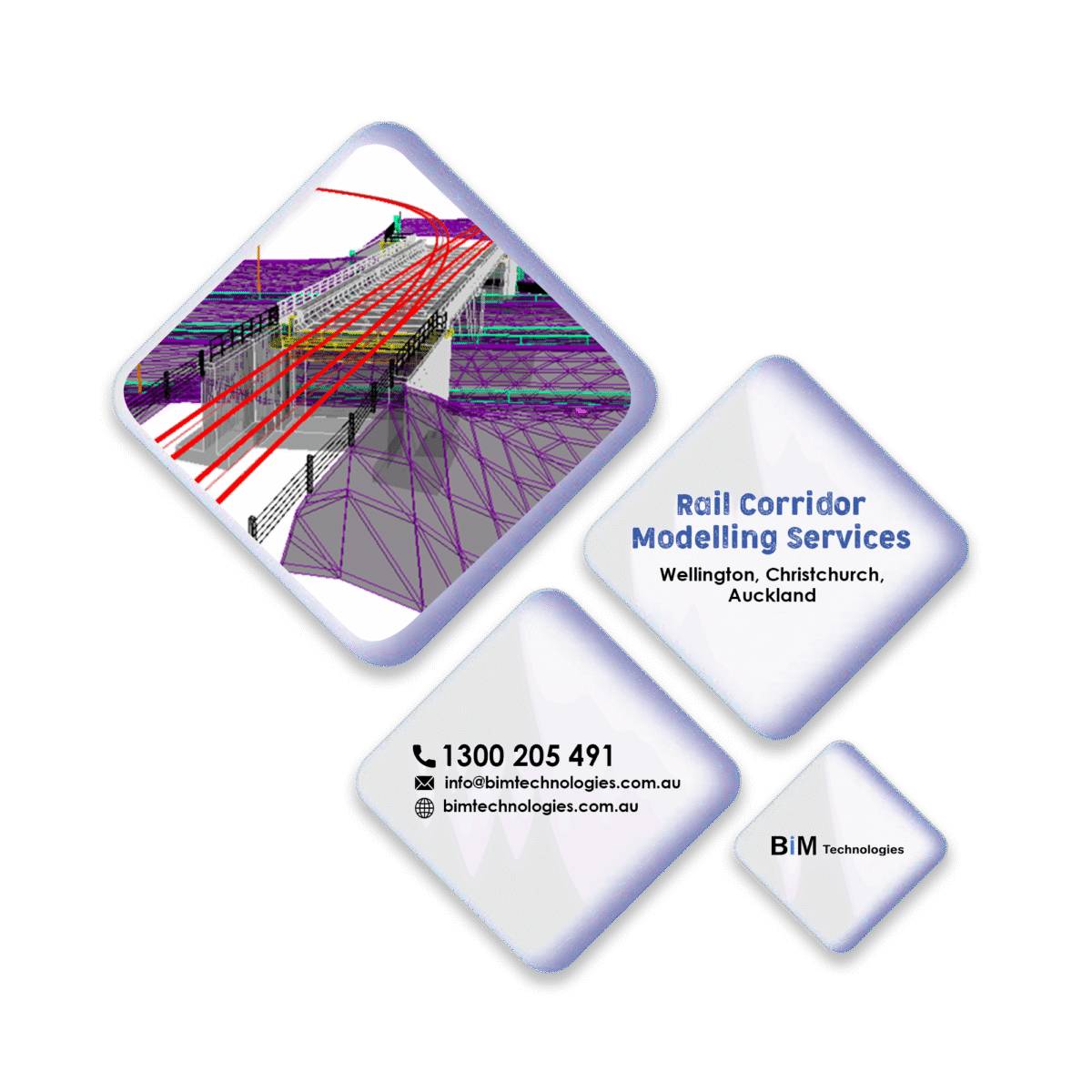
The process of creating a digital 3D representation of the railway line, including the track, surrounding terrain, and associated infrastructure, is known as rail corridor modelling. This particular service makes use of advanced technologies to generate accurate models that enhance multiple aspects of the railway projects.
With the help of Autodesk 3D, the designers can easily build the model of a rail track corridor along with the required detailing. This particular service has been quite helpful for the railway engineers, engineering service providers, designers, and project engineers.
Key Technologies Used in Rail Corridor Modelling Services :-
(1) Building Information Modelling (BIM) :
The use of BIM is quite crucial for creating detailed digital models of the railway infrastructure, enabling visualisation, analysis, and establishing collaboration across the entire project lifecycle. Additionally, BIM aids in reducing the overall cost of the project by identifying the issues at an early stage.
(2) Light Detection and Ranging (LiDAR) :
This technology offers highly accurate 3D data, which is required for designing a detailed terrain model as well as for feature extraction. This technology further aids in optimising the infrastructure planning, maintenance, and safety along the rail corridors.
(3) Geographic Information System (GIS) :
Well, GIS integrates with BIM and other data sources to provide geospatial context for the models, facilitating analysis and decision making with respect to the surrounding environment and other infrastructure elements.
Key Components of Rail Corridor Modelling Services :-
(i) Geometry :
It includes the horizontal as well as the vertical alignment of the tracks, curves, and transitions.
(ii) Terrain :
It includes the existing ground surface, slopes, embankments, and cuttings, which are modelled with the help of the data being generated through LiDAR scans and digital elevation models.
(iii) Assemblies :
Includes the predefined cross-sections of the railway, including the track structure, ballast, and any associated structures.
(iv) Templates :
It is used to define the geometry and materials of the track structure, allowing consistent application along the corridor.
(v) Corridor :
This component ties together all other components, defining the extent and behaviour of the railway line.
Benefits Gained Through Rail Corridor Modelling Services :-
As discussed, rail corridor modelling services are essential for delivering modern, efficient, and sustainable railway systems. By incorporating advanced technologies and collaborative workflows, the engineer could optimise every stage of the project, starting from the initial planning stage to its final execution.
In addition to that, here are some of the benefits the users could derive from this particular service includes :
(a) Better planning and design :
Rail corridor modelling gives engineers and planners a clear, 3D view of the area where tracks and infrastructure will be built. This helps them design smarter, avoid mistakes, and make well-informed decisions before the actual construction phase begins. In a way, this service also prevents the occurrence of any kind of huge replacement costs.
(b) Time and cost savings :
The real-time progress tracking of this service aids in identifying the delays or obstacles at an early stage. As a result, the delays or expensive changes that might occur during construction get eliminated. This simple measure also speeds up the entire planning and approval process.
(c) Improved safety :
Detailed models that are generated out of this service show potential hazards and help in planning safer construction zones and track layouts. This eventually reduces the risk of accidents for both workers and future rail users.
(d) Accurate and up-to-date data :
Using tools like drones and 3D scanning, rail corridor modelling provides highly accurate and current information about the site. This leads to better-quality workflow and fewer surprises.
(e) Easier collaboration :
With a visual model, all teams, such as the engineers, surveyors, architects, and contractors, can see and understand the same data. This makes communication clearer and project coordination much easier.
(f) Environmentally friendly planning :
By understanding the land and surroundings, rail corridor modelling helps reduce environmental impact. Designers can adjust plans to avoid natural habitats, water sources, or sensitive areas.
(g) Stakeholders’ communication :
The best part about this service is that it facilitates a smooth flow of communication with the stakeholders. The detailed models that are generated out of this service display the crucial information to the stakeholders. As a result, this promotes transparency and fosters collaboration between the involved members of the project.
Challenges Involved in Rail Corridor Modelling Services :-
So far, it has been made clear that rail corridor modelling services involve creating a detailed digital representation of the railway network, track infrastructure, and surrounding terrain.
However, there is are certain set of challenges which could influence the entire project, such as :
[1] Acquisition and integration of data :
One of the biggest strengths of rail corridor modelling is its ability to gather and use data from multiple sources. These include spatial data like terrain and track layouts, operational data such as train movements and signal positions, and environmental data for weather or land conditions.
However, collecting accurate data over long and often remote corridors can be difficult and expensive. Specialized tools like LiDAR or drones are often needed to capture key measurements such as track geometry or wear.
Once collected, this data must be integrated and standardized, which can be challenging due to differences in format, scale, and detail. On top of that, many rail systems still rely on outdated technologies, making it hard to connect with the new modelling tools that too with an old infrastructure.
[2] Computational and technical complexities :
Rail corridors are constantly changing due to train traffic, weather conditions, and ongoing maintenance. To manage these changes effectively, it’s essential to build highly accurate models that represent everything starting from the track curves to signal placements that too in fine detail.
However, maintaining precision isn’t a one-time job as it requires real-time data updates and continuous processing, which can significantly strain the technical systems. Additionally, modelling must account for uncertainties such as uneven wear patterns or unexpected environmental impacts. This adds another layer of complexity, especially when predictions are used to plan maintenance or assess long-term performance under different conditions.
[3] Modelling accuracy and precision :
Modelling entire rail corridors generates an enormous amount of data, such as high-resolution maps to real-time monitoring of rail traffic. Processing all this information efficiently requires powerful computers and advanced algorithms. Even with the right tools, ensuring all systems communicate with each other is difficult because not all rail networks follow the same data standards or communication protocols.
To create highly detailed and useful models, engineers may need to use advanced methods like machine learning or physics-based simulations, which require both deep expertise and substantial computing power. Without the right technical setup, projects can quickly become slow, costly, or error-prone.
[4] Operational and project management challenges :
Rail corridor modelling projects usually involve a wide range of stakeholders, including engineers, government agencies, safety regulators, and construction teams. Each group has its own goals, making collaboration and clear communication essential for success. Navigating strict regulatory requirements and maintaining the highest safety standards is also critical throughout the process.
In addition, these projects often come with high costs which are both in terms of technology and skilled personnel. As rail networks move toward digital systems, cybersecurity becomes an important concern. Protecting sensitive data and ensuring system integrity must be prioritized to prevent disruptions or breaches.
The above challenges need to be addressed in order to develop an effective and robust rail corridor modelling solution that supports efficient and safe railway operations and future network expansion.
Conclusion :-
Rail Corridor Modelling Services play a vital role in enhancing the planning, safety, and efficiency of modern rail projects. And if you want to execute your project with the support of such advanced tools, then make sure to contact the experts ata BIM Technologies.
Our team streamlines the entire procedure and offers a complete view of the construction assignment.